
‘Two-speed’ European fleet electrification driven by tax, infrastructure and RVs, Alphabet finds
Corporate fleets across the EU are electrifying at two distinct speeds, with national tax rules, charging infrastructure and residual values dictating adoption far more than corporate ambition, according to new analysis from Alphabet.

Corporate fleets across Europe are electrifying at two distinct speeds, according to Alphabet’s analysis
Where policy, cost and infrastructure align, operators are rapidly transitioning to electric vehicles; where they do not, adoption either stalls or shifts towards transitional technologies such as plug-in hybrids.
Accounting for around 60% of all new EU car registrations, the corporate channel plays a central role in European fleet decarbonisation. While the European Commission’s proposed Clean Corporate Vehicles Regulation (CCVR) would set electrification targets for large companies across member states, Alphabet warns that mandates alone will only drive uptake if national governments put the right local incentives and infrastructure in place.
Across the wider EU market, battery electric vehicles (BEVs) accounted for 22.7% of new car registrations in the first nine months of 2026, up from 16.1% a year earlier – industry body ACEA attributes this to purchase incentives and a broader line-up of electric models.
But Alphabet’s research shows that tax rules, charging infrastructure and residual values are driving a sharp fleet divide, as demonstrated by the performance of individual markets.
Corporate BEV uptake ranges from 59% in Belgium to around 5% in Italy.
Belgium’s lead follows its phased withdrawal of tax deductibility for combustion company cars, with the corporate BEV share up a further six percentage points year on year.
Italy, by contrast, recorded a 72.4% increase in plug-in hybrid registrations in the first nine months of 2026 – evidence of a different transition pathway rather than resistance to change.
And across Europe’s four largest markets, corporate BEV adoption is currently no faster than private uptake and, in some cases, slower.
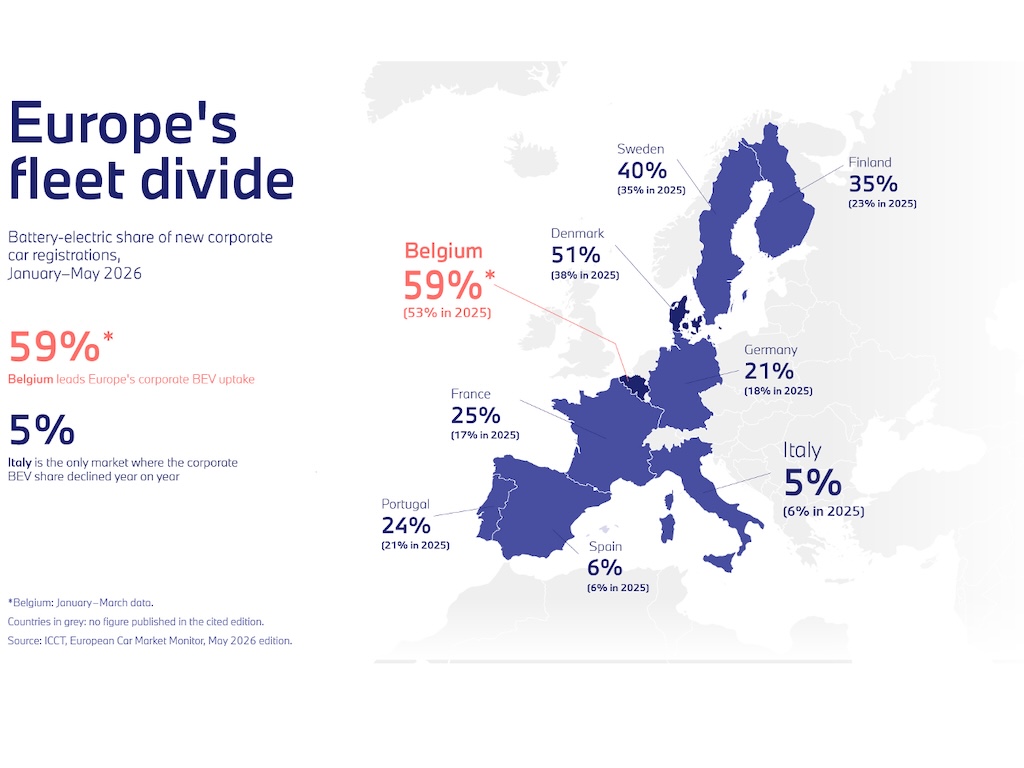
By combining registration data with tax treatment, charging density and residual-value development, Alphabet’s analysis shows why the same vehicle can present a different business case at every border.
Underscoring this, Alphabet’s European Fleet Emission Monitor (EFEM) 2026 reveals that while 27% are accelerating electrification and CO2 reduction, 19% are waiting for greater regulatory clarity and 15% are using interim technologies such as hybrids. Even so, 61% of European fleet decision-makers expect fully electric fleets – or have already made the switch.
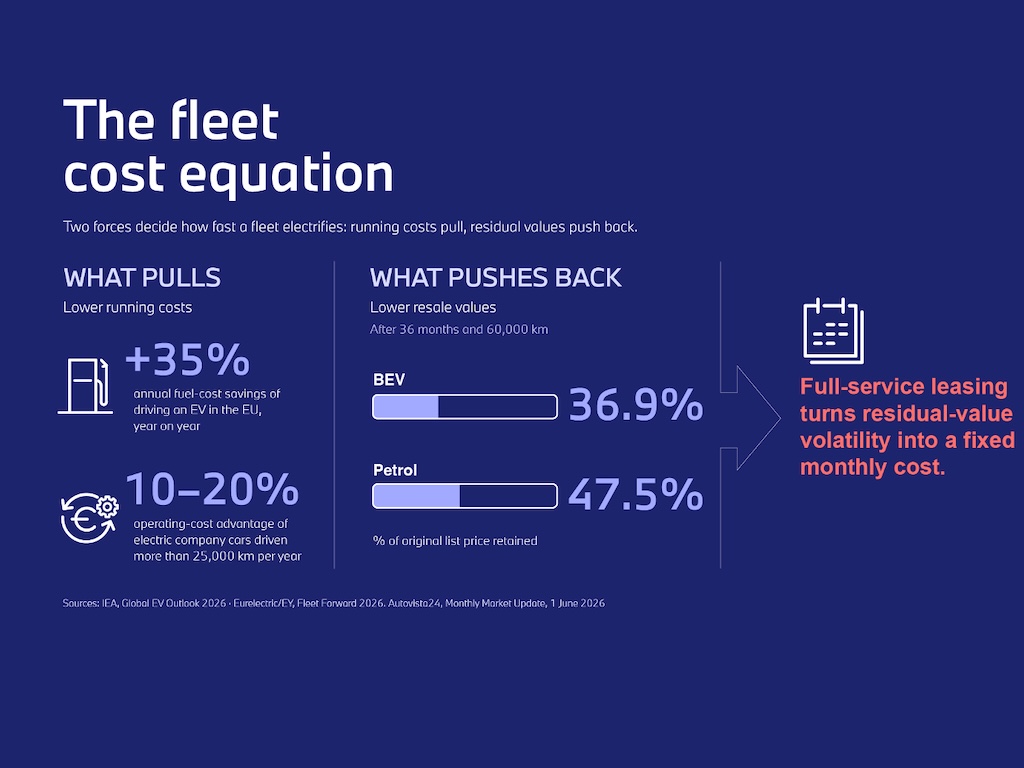
The operational case for electrification is strengthening. Annual fuel-cost savings from driving an EV in the EU rose by 35% year on year, while independent analysis indicates that electric company cars covering more than 25,000km (15,534 miles) annually can reduce operating costs by 10% to 20% compared with combustion models. Depreciation remains the counterweight: in Germany, battery-electric vehicles retain 36.9% of list price after 36 months and 60,000km (37,282 miles), compared with 47.5% for petrol models. Full-service leasing can turn that residual-value exposure into a defined monthly cost, with the lessor assessing and managing the risk at portfolio scale.
Alphabet’s own portfolio, spanning markets on both sides of the divide, reflects the business case. Electrified vehicles now account for 42% of the company’s fleet of more than 800,000 vehicles, compared with almost 30% in 2023 and 35% in 2024. In 2025, BEVs represented 28.5% of around 249,000 new contracts, with volumes increasing by more than 35% year on year.
Corporates are also building Europe’s used-EV market. Company fleets typically turn vehicles over faster than private owners, which means fleet returns reach the second-hand market quickly. Markets that enable fleets to electrify today are therefore also building the more affordable used-EV stock that can broaden access tomorrow.
Jesper Lyndberg, CEO of Alphabet International, said: “Europe’s fleet transition will not be unlocked by one mandate or one timetable. More than two in five vehicles we manage are already electrified, showing that demand is real when the business case is credible. The decisive question is which technology mix fits each market and use case – and that requires a calculated answer, not a gut feeling.”
What the analysis means for international fleets
- Start with local economics: Model tax treatment and ownership costs country by country.
- Match technology to use case: Prioritise mileage and operating profiles with the strongest TCO case.
- Manage residual-value exposure: Use portfolio-scale leasing to convert volatility into predictable cost.
- Track national CCVR implementation: Anticipate how proposed EU targets may reshape local market conditions.
Alphabet InternationalEuropean fleetsfleet electrification
Natalie Middleton

Natalie has worked as a fleet journalist for nearly 20 years, previously as assistant editor on the former Company Car magazine before joining Fleet World in 2006. Prior to this, she worked on a range of B2B titles, including Insurance Age and Insurance Day. Natalie edits all the Fleet World websites and newsletters, and loves to hear about any latest industry news - or gossip.