
Volvo marks 50 years since first electric car
Volvo Car UK is marking 50 years since the unveiling of its first electric vehicle, the 1976 Elbil prototype, by showcasing the results of half a century of EV development.

The Volvo Elbil offered a driving range of 31 miles and required 10 hours to charge
Unveiled in November 1976, the distinctive orange four-seater Elbil was powered by twelve 6V lead-acid batteries totalling 4.3kWh. It offered a driving range of just 31 miles, required 10 hours to charge and delivered 13hp of power to reach a top speed of 43mph.
Only two examples of the Elbil were ever built. Alongside the orange passenger prototype, Volvo produced a butter-yellow, two-seat delivery vehicle featuring a sliding door. Part-funded by the Swedish state, it was developed for employees of Televerket, Sweden’s former state-owned telecommunications authority, to carry out zero-emission deliveries around Gothenburg.
Fast forward 50 years, and Volvo’s newest EV – the all-electric EX60 medium SUV – comes with advanced lithium-ion battery packs, offers up to 503 miles of range and can charge from 10-80% in just 19 minutes.
Despite 50 years of EV progress, both cars share key priorities for innovation, engineering and safety.
Under its boxy exterior, the Elbil was carefully engineered to keep overall weight to a minimum. Glass‑fibre‑reinforced plastic was used for the bonnet and tailgate, with aluminium used for the doors and roof panels, helping keep kerb weight to just 1,200kg.
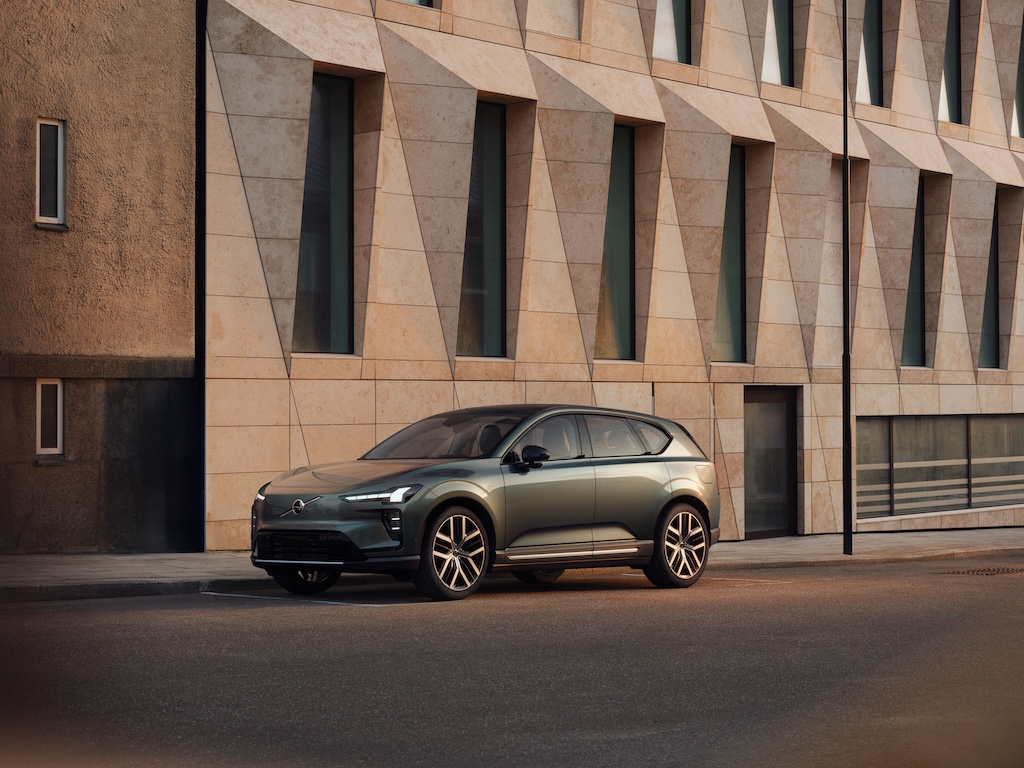
The Volvo EX60 offers up to 503 miles of range and can charge from 10-80% in 19 minutes
The EX60 has been designed with an equally strong commitment to weight reduction. As the first car to be built on Volvo’s SPA3 modular electric vehicle architecture, it features innovations such as cell-to-body technology and mega-casting production techniques.
To enhance space efficiency, the Elbil’s 9.5kW motor was integrated with the rear axle and paired with a specially developed stepless transmission.
For the EX60, Volvo has used its next generation, in-house developed e-motors to deliver performance through three different powertrain options – the P6, P10 and P12, each delivering 374hp, 510hp and 680hp respectively.
And on the safety front, each seat in the 1976 Elbil was fitted with a three-point seatbelt – a feature Volvo first introduced as standard in 1959 – while its bright orange paintwork was chosen to improve visibility.
Meanwhile, the EX60 that launched this year introduced the world’s first multi-adaptive safety belt for front-row occupants, working alongside a safety cage reinforced with boron steel.
In addition, the EX60 also offers Volvo’s latest Connected Safety features, using shared vehicle data to provide real-time hazard alerts, including roadworks, accidents and vulnerable road users, via an over-the-air update.
Nicole Melillo Shaw, managing director of Volvo Car UK, commented: “The Elbil was a bold example of Volvo’s forward-thinking approach to electrification, demonstrating our ambition to explore new technologies long before electric vehicles became mainstream. Fifty years on, the EX60 shows just how far we’ve come, combining exceptional electric range, rapid charging and pioneering safety innovations.
“While the technology has evolved significantly, what we stand for remains unchanged – to develop cars that make life easier, safer and better for people. The EX60 is a testament to that commitment and an exciting example of what the future holds for Volvo Cars.”
Side-by-side: 1976 Volvo Elbil vs. Volvo EX60 P12 AWD
| Volvo Elbil
|
Volvo EX60 P12 AWD
|
|
| Powertrain | 1 x electric motor, rear-wheel drive | 2 x electric motor, all-wheel drive |
| Power | 13hp | 680hp |
| Top speed | 43mph | 112mph |
| 0-62mph | N/A | 3.9 seconds |
| Range | 31 miles | 503.3 miles WLTP |
| Charging time | 10 hours (AC) | 19 mins (10-80%, DC 370kW) |
| Battery type/size | Lead acid/4.3kWh | Lithium-ion/117kWh |
| Bi-directional charging | No | Yes |
| Kerb weight | 1,200kg | 2,330kg |
Natalie Middleton

Natalie has worked as a fleet journalist for nearly 20 years, previously as assistant editor on the former Company Car magazine before joining Fleet World in 2006. Prior to this, she worked on a range of B2B titles, including Insurance Age and Insurance Day. Natalie edits all the Fleet World websites and newsletters, and loves to hear about any latest industry news - or gossip.