
Commercial vehicle-to-grid charging could unlock emerging energy resource
Electric vehicles could become a significant source of distributed energy storage, helping manage peak demand and make better use of renewable electricity, according to new analysis.
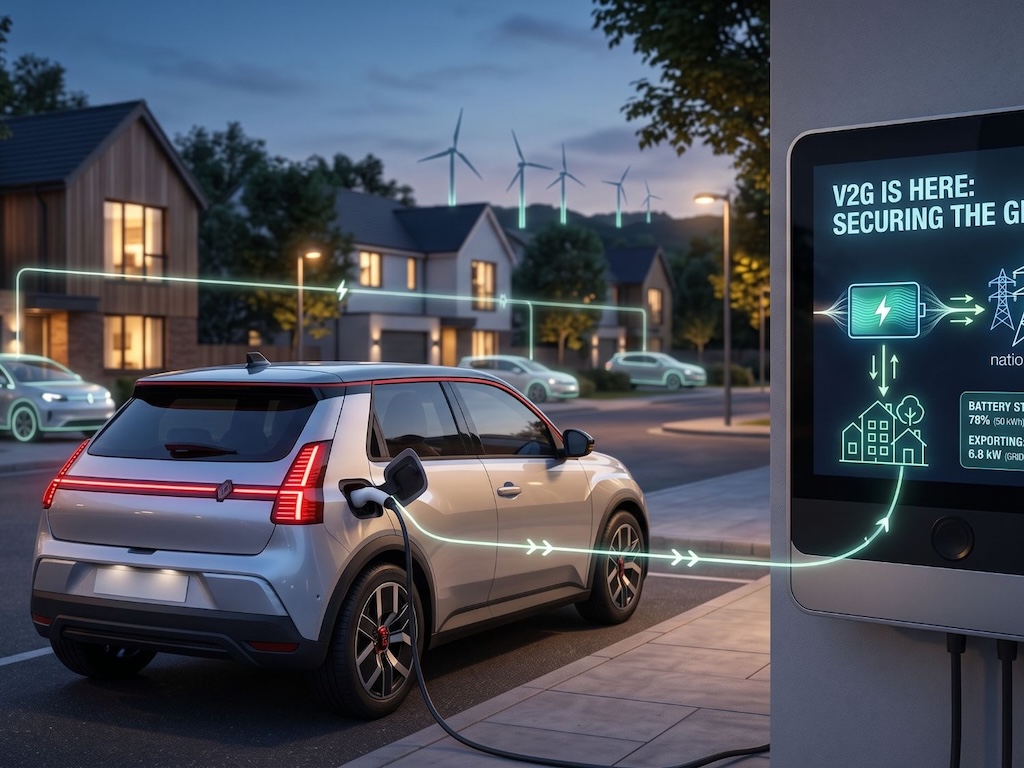
The research highlights the potential for the UK’s growing electric car fleet to support local grids and renewable energy
Published as the UK approaches the winter electricity-demand period, the research by smart EV charging consultancy Versinetic identifies commercial vehicle-to-grid (V2G) services emerging across international markets and highlights the potential for the UK’s growing electric car fleet to support local grids and renewable energy.
The study on Vehicle-to-Grid is Here, Finally: Where V2G Stands in 2026 is authored by Versinetic EV analyst Julian Skidmore and examines the development of V2G technology across major international markets, including the UK, Australia, Germany, France, the Netherlands, Norway, the US and Japan.
It finds that, after almost 30 years of research and trials, V2G is moving towards commercial deployment, with regulatory progress, greater interoperability and emerging business models beginning to support wider adoption.
Key findings include that EVs could become a significant distributed energy resource.
Versinetic’s analysis estimates that the UK’s current battery-electric vehicle fleet represents around 114 GWh of theoretical storage capacity. Set alongside roughly 137 GWh of installed grid-scale battery storage, this points to a theoretical combined pool of about 251 GWh – nearly doubling the storage the grid could in principle call on.
These are two separate measures: the 137 GWh is installed grid-connected capacity, while the EV figure is the theoretical total capacity of the car fleet, just a fraction of which could be made available through V2G today.
The combined figure illustrates the scale of the opportunity, rather than the amount of energy currently available to the grid. Actual V2G capacity would depend on vehicle compatibility, driver participation, battery availability and the infrastructure needed to export electricity.
Fully electric car fleet would transform the scale of storage
The research highlights that transitioning to a fully electric car fleet would fundamentally transform the scale of energy storage.
Battery-electric vehicles currently represent approximately 7.15% of UK cars. If every UK car were electric, Versinetic calculates that their combined batteries could theoretically store enough electricity to meet around 48 hours of current UK electricity consumption, assuming no other energy sources were available.
The scenario demonstrates the long-term potential of distributed vehicle batteries, although practical deployment would depend on charging patterns, grid connections, energy-market arrangements and the proportion of battery capacity drivers are willing to make available.
Smarter charging could reduce pressure on neighbourhood grids
Versinetic’s modelling scenario also illustrates how spreading EV charging across 24 hours could reduce average charging demand in a 450-EV neighbourhood example from a local substation’s limit of around 300 kW to 100 kW.
V2G can support household or local network demand during peak periods. For the 300-home (450 EV) scenario in the previous paragraph, EVs could provide up to 2.1 MW, massively reducing pressure on a local substation. They can also improve renewable generation with intelligently managed charging and export.
Commercial models beginning to emerge
The research identifies progress across international markets as vehicle manufacturers, energy suppliers and charging providers develop the technology and commercial arrangements needed for V2G.
Nissan became the first manufacturer in the UK to gain G99 grid-code certification for an AC V2G solution following a year-long trial at the University of Nottingham using the car’s on-board charger rather than a bidirectional unit to lower the cost of entry. Versinetic identifies 27 V2G-capable models in the UK from manufacturers including BYD, Renault, Volkswagen, Mercedes-Benz, Volvo, Kia, Audi, BMW and Hyundai. However, commercial V2G packages are currently more restricted. For example, only Octopus Energy in the UK has a package, currently only compatible with the BYD Dolphin and the V2G Zaptec Pro charger.
Drivers could become active participants in the energy system
Versinetic estimates that British consumers are investing around £20bn a year in electric vehicles, effectively funding the growth of a potential distributed battery resource as part of the transition to electric transport.
V2G already allows participating drivers to benefit from flexibility services. As commercial barriers fall further and adoption increases, it will help energy suppliers and network operators manage demand. The consultancy says successful deployment will depend on making these services straightforward, financially worthwhile and compatible with drivers’ everyday mobility needs.
Dunstan Power, managing director at Versinetic, said the argument around EVs and the grid is starting to turn on its head.
“We have spent years asking how the electricity system will cope with millions of electric cars. V2G means those same cars could become part of how we manage that challenge.
“After nearly 30 years of research and trials, that is the real significance of V2G moving towards commercial reality. We can start thinking about the EVs arriving on our roads not simply as vehicles that need electricity, but as millions of batteries with a potential role in the energy system.
“As winter approaches, the opportunity to manage peak demand and make better use of renewable electricity becomes particularly relevant. The challenge now is to turn that potential into practical services that work for drivers, energy suppliers and network operators.”
Ahead of next week’s Autumn Budget, Versinetic says policymakers should also consider how charging infrastructure, interoperability standards and energy-market arrangements can support the commercial development of V2G. Clearer routes for drivers to participate in flexibility services could help unlock the value of vehicle batteries while ensuring motorists retain control over when and how their cars are charged.
Versinetic’s full report is online at the company’s website.
Vehicle-to-grid (V2G)Versinetic
Natalie Middleton

Natalie has worked as a fleet journalist for nearly 20 years, previously as assistant editor on the former Company Car magazine before joining Fleet World in 2006. Prior to this, she worked on a range of B2B titles, including Insurance Age and Insurance Day. Natalie edits all the Fleet World websites and newsletters, and loves to hear about any latest industry news - or gossip.