
Renault Group unveils 36-model blitz to power ‘futuREady’ strategy
Renault Group has officially unveiled ‘futuREady’, a bold strategic roadmap to 2030 that commits to a massive 36-model product offensive and breakthrough EV range of up to 466 miles.
The bold strategic roadmap commits to a massive 36-model product offensive by 2030
Led by CEO Francois Provost, this ambitious “success system” aims to make the group the “benchmark for the European automotive industry on the global stage”.
For Renault, the plans seek to strengthen European leadership, accelerate electrification and “go faster internationally to confirm Renault as the number one French automotive brand worldwide”.
In Europe, the automaker aims to launch 12 new products between now and 2030, building on the smaller segments with models such as the Twingo E-Tech electric to expand into the A-segment, while “initiating a new offensive” in the C- and D-segments. For the latter, Renault is preparing a second wave of vehicles, with a new generation of electric and hybrid models that include the new Scenic and Megane.
The French OEM also plans to deploy electrification across the range, extending the full hybrid E-Tech offering beyond 2030 in Europe and international markets.
It will also develop a new generation of electric vehicles based on the new RGEV medium 2.0 platform, that’s “built for range, efficiency and ultra-fast charging”. Designed for segments from smaller cars to family models, the modular and versatile architecture is able to accommodate all vehicle body styles. It will be implemented in three configurations: 100% electric with a range of up to 466 miles (750km) WLTP, 4×4 electric with a towing capacity of up to two tonnes, or electric with a range extender, increasing the total range to 870 miles (1,400km).
Plans will also seek to cut the cost of EVs by 40% and extend the E-tech hybrid offers beyond 2030, internationally and in versions under 150hp.
Vans are another growth area and Renault will bring to market a new generation of eLCVs built around an 800V software-defined vehicle (SDV) architecture that will underpin the new Trafic van E-Tech electric and will enable a range of up to 279 miles (450km).
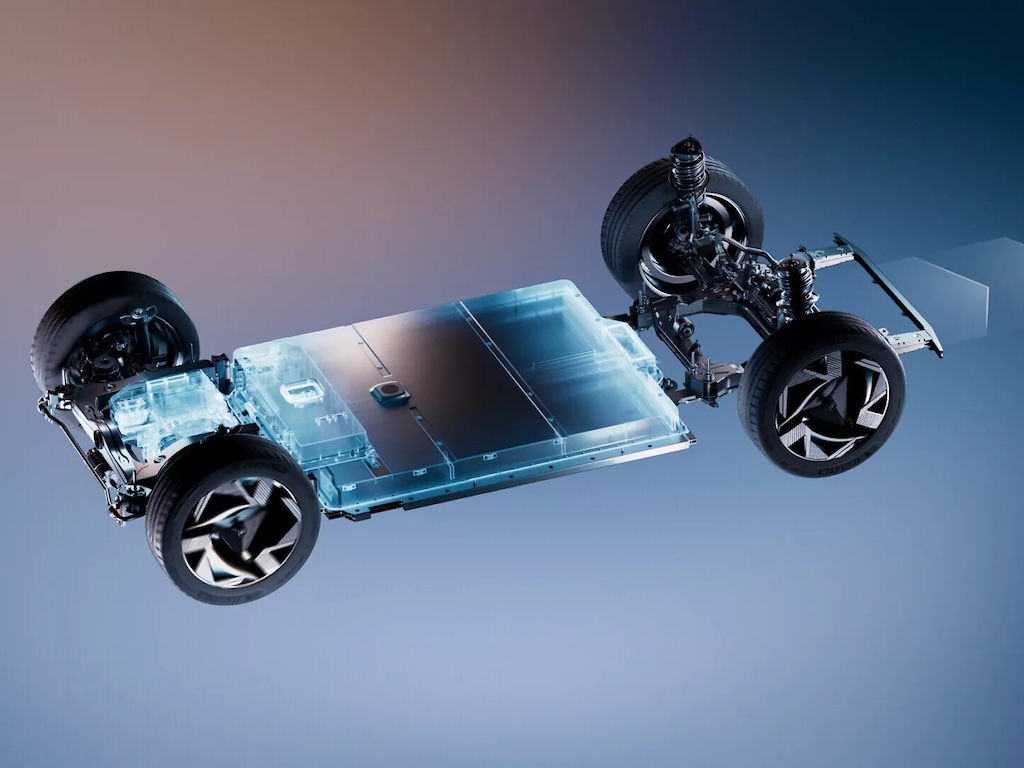
The new RGEV medium 2.0 platform is designed for segments from smaller cars to family models
Globally, Renault will step up the brand offensive on international markets with the launch of 14 new models between now and 2030.
The overarching target, by 2030, is to sell more than two million cars and vans, of which more than half will go to markets outside Europe, and increase the proportion of electrified sales to 100% in Europe and 50% outside Europe.
For Dacia, plans will centre around having the “most competitive offering based on price, cost and value for customers” and to accelerate electrification to reach two-thirds of sales in 2030. Dacia will also continue its offensive in the C segment, which will account for one-third of sales in 2030, and will build on its expertise in 4×4 systems, the Group E-Tech hybrid and its leadership in LPG vehicles.
By 2030, the brand will have shifted towards electric mobility, increasing the number of electric vehicles in its range from one to four.
On the Alpine side, the performance brand will launch the next generation of its A110 model, based on the Alpine Performance Platform, and will building on the A290 and A390 models to attract new customers. Alpine will also develop “even more exclusive and personalised offerings” through limited series such as the A110 R Ultime.
François Provost, CEO of Renault Group, said: “At Renault Group, we know where we come from. Today, we know where we want to go, how and who with. And all of this in pursuit of one goal: to better serve our customers, ultimately delivering clean, affordable mobility tailored to their needs, based on the strength of our brands and vehicles.”
Natalie Middleton

Natalie has worked as a fleet journalist for nearly 20 years, previously as assistant editor on the former Company Car magazine before joining Fleet World in 2006. Prior to this, she worked on a range of B2B titles, including Insurance Age and Insurance Day. Natalie edits all the Fleet World websites and newsletters, and loves to hear about any latest industry news - or gossip.