
Stellantis tests lighter, faster-charging EV battery
Stellantis has started real-world testing of “breakthrough” EV battery technology that could deliver a bunch of benefits to future EVs by the end of this decade.
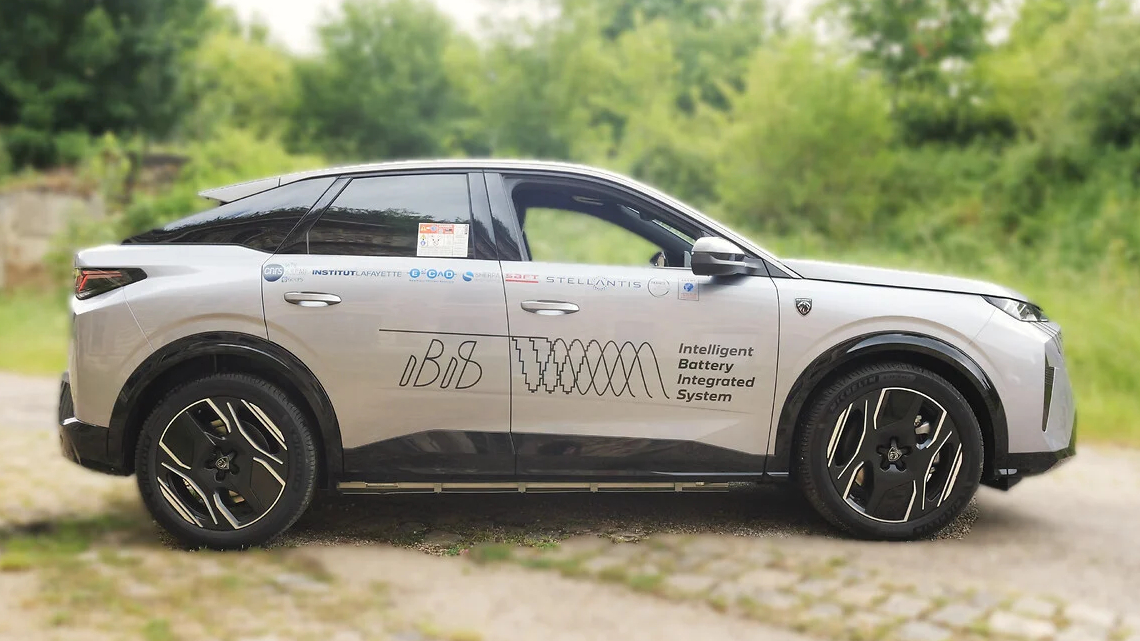
IBIS technology could end up in Stellantis production vehicles by the end of the decade
The automotive giant has teamed up with Saft, a subsidiary of global multi-energy firm TotalEnergies, to unveil a working prototype featuring the Intelligent Battery Integrated System (IBIS) technology on a Peugeot E-3008.
IBIS reimagines the electric powertrain by eliminating the charger and inverter from its electric vehicles and integrating the control modules directly into the battery pack, regardless of chemistry or application. This architecture supports both alternating current (AC) and direct current (DC), supplying electric energy directly to the motor or grid, while simultaneously supplying the vehicle’s 12V network and auxiliary systems.
The carmaker claims big benefits for the system. This includes up to a 10% energy efficiency improvement (WLTC cycle) and 15% power gain (234hp vs. 204hp) with the same battery size.
It’s also said to deliver key weight and space savings, reducing vehicle weight by some 40kg and freeing up to 17 litres of volume, enabling better aerodynamics and design flexibility.
There are potential charging benefits too; early results show a 15% reduction in charging time (e.g., from 7 to 6 hours on a 7 kW AC charger), along with 10% energy savings.
And the new integrated system could simplify maintenance, with easier servicing and enhanced potential for second-life battery reuse in both automotive and stationary applications.
IBIS also streamlines maintenance and facilitates the reuse of second-life batteries in stationary automotive applications by reducing the need for extensive reconditioning.
With real-world road testing now underway, both firms says the milestone marks a major leap forward in advancing electrification for both mobile and stationary energy applications
Ned Curic, chief engineering and technology officer at Stellantis, commented: “By rethinking and simplifying the electric powertrain architecture, we are making it lighter, more efficient and more cost-effective. These are the kinds of innovations that help us deliver better, more affordable EVs to our customers.”
Hervé Amossé, EVP energy storage systems at Saft, commented: “The IBIS project is a powerful testament to Saft’s innovation leadership. By embedding IBIS technology into our next-generation applications, we’re unlocking a new era of intelligent, flexible, and sustainable energy solutions. Saft continues to lead the way in advanced research, offering long-term, cost-effective solutions tailored to evolving market needs.”
The debut of the working prototype follows years of design, modelling and simulation by Stellantis and Saft, with support from E2-CAD, Sherpa Engineering, and leading French research institutions.
The focus now shifts to real-world testing under representative driving conditions, which could pave the way for the integration of IBIS technology into Stellantis production vehicles by the end of the decade.
Alongside automotive applications, the IBIS architecture could be used for other industries rail, aerospace, marine and data centres.
Stellantis Intelligent Battery Integrated System (IBIS) technology
Natalie Middleton

Natalie has worked as a fleet journalist for nearly 20 years, previously as assistant editor on the former Company Car magazine before joining Fleet World in 2006. Prior to this, she worked on a range of B2B titles, including Insurance Age and Insurance Day. Natalie edits all the Fleet World websites and newsletters, and loves to hear about any latest industry news - or gossip.