
Speed has greater impact on EV range than heat, Geotab reveals
Driving speed has a greater impact on electric vehicle range than summer heat, especially for larger vehicles on longer trips, according to new in-depth research carried out by Geotab.
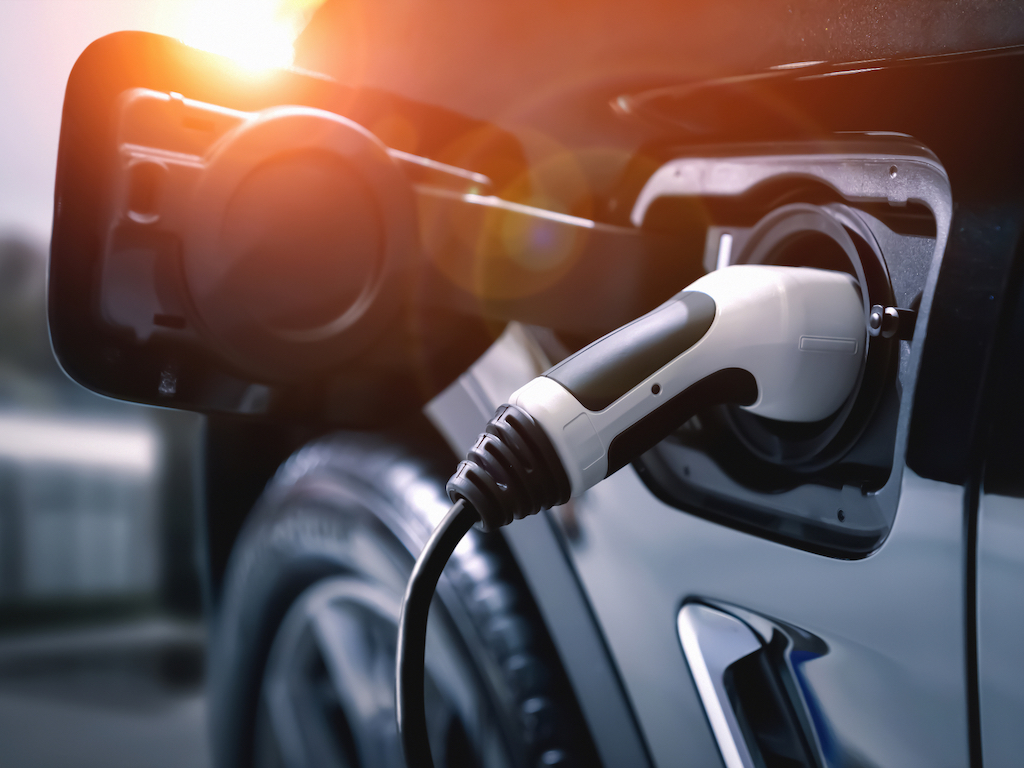
While hot weather does have an effect, driving speed can be the single biggest factor in range loss
Published as temperatures continue to soar in the UK, and many electric vehicle drivers worry about how heavy air conditioning use will affect their range, the data shows that while hot weather does have an effect, driving speed can be the single biggest factor in range loss.
The study explored anonymised telematics data from more than three million trips and compared how temperature and speed affect energy use in light-duty EVs, including saloons and cargo vans.
At higher speeds (50-80mph / 80-129km/h) in hot temperatures (30°C /86°F), aerodynamic drag has a far greater effect on range than cabin cooling.
The data shows that even modest increases in speed lead to steep range losses. For example, a 65kWh electric van cruising at 50mph in 30°C heat with the air conditioning on has a typical range of around 143 miles (230km). Increase that speed to 60mph (97km/h), and range drops to 121 miles (195km/h). At 70mph (113km/h) it falls further to 103 miles (166km), and by 80mph (129km/h), you’re down to just 88 miles (142km). That’s a 39% drop in range between 50 and 80mph (80-129km/h).
The pattern is similar for electric saloons, although they’re slightly more aerodynamic. At 50mph (80km/h) at 30°C, you can expect 277 miles (446km). At 60mph (97km/h): 251 miles (404km). At 70mph (113km/h): 226 miles (364km). And at 80mph (129km/h): 200 miles (322km) – a 28% drop from the most efficient cruising speed.
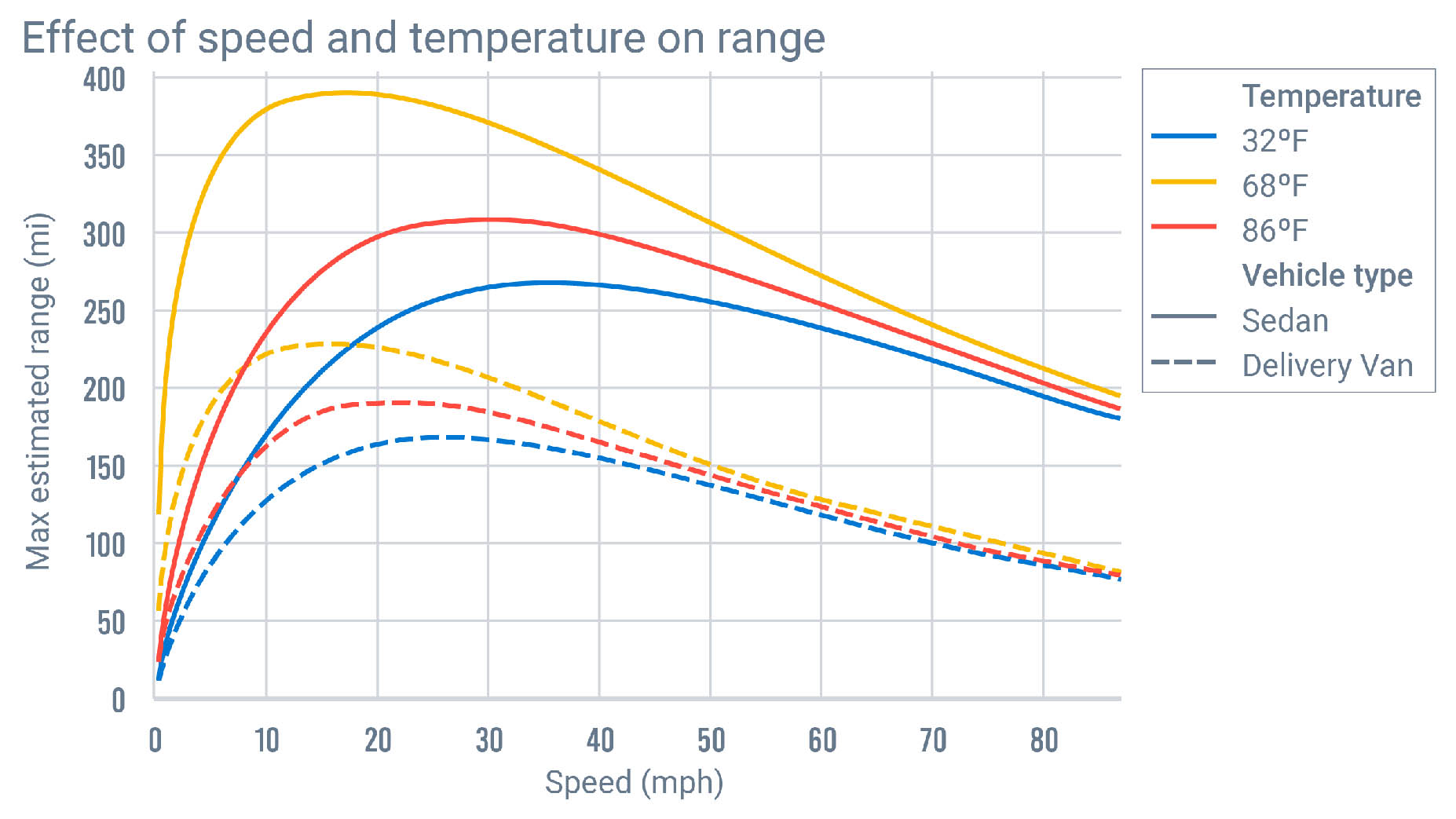
Geotab said the sharp decline is the result of simple physics. The faster you go, the more your car has to fight air resistance. Aerodynamic drag increases with the square of your speed, so doubling your speed requires four times the energy just to overcome wind resistance. That’s far more than an EV’s A/C system will ever use.
Charlotte Argue, senior manager, sustainability at Geotab, explained: “Drivers tend to worry about using the aircon in hot weather, but our data shows that your right foot can make the biggest difference, particularly at high speeds.
“Just slowing down by 10 or 15mph (16-24km/h) can extend your range by 20-30%, depending on the vehicle.”
Geotab added that temperature still matters; but mostly at low speeds.
In summer, the impact of heat is largely visible at lower speeds, where drag is otherwise minimal. In these conditions, the constant draw from air conditioning becomes more noticeable. But the faster you drive, the less significant temperature becomes relative to the energy required to maintain speed.
“Modern EVs have increasingly large batteries, and many can comfortably handle most daily driving – including fleet routes – on a single charge,” added Argue. “But range, on EVs or ICE vehicles, will always vary with real-world conditions: temperature, topography, traffic, and yes, speed.”
Practical steps to maximise EV range this summer
Geotab also outlined a new few simple to help drivers stretch range without compromising comfort:
- Reduce your speed – even small reductions in highway speed can make a big difference. For many vehicles, dropping from 70mph to 60mph can add 10-20% more range.
- Precondition the cabin while the vehicle is still plugged in, using mains power rather than the battery.
- Use A/C efficiently – start cool, use recirculate mode and, if equipped, prioritise seat ventilation over full cabin cooling.
- Avoid aggressive acceleration and braking, and make the most of regenerative braking.
- Park in the shade to keep the cabin cool and reduce A/C load at start-up.
- Avoid fast charging during extreme heat, which can put additional strain on the battery and may contribute to faster long-term degradation.
Natalie Middleton

Natalie has worked as a fleet journalist for nearly 20 years, previously as assistant editor on the former Company Car magazine before joining Fleet World in 2006. Prior to this, she worked on a range of B2B titles, including Insurance Age and Insurance Day. Natalie edits all the Fleet World websites and newsletters, and loves to hear about any latest industry news - or gossip.