
Europe’s first V2G-enabled car sharing service goes live
Europe’s first large‑scale vehicle‑to‑grid car sharing service has launched in the city of Utrecht in the Netherlands.
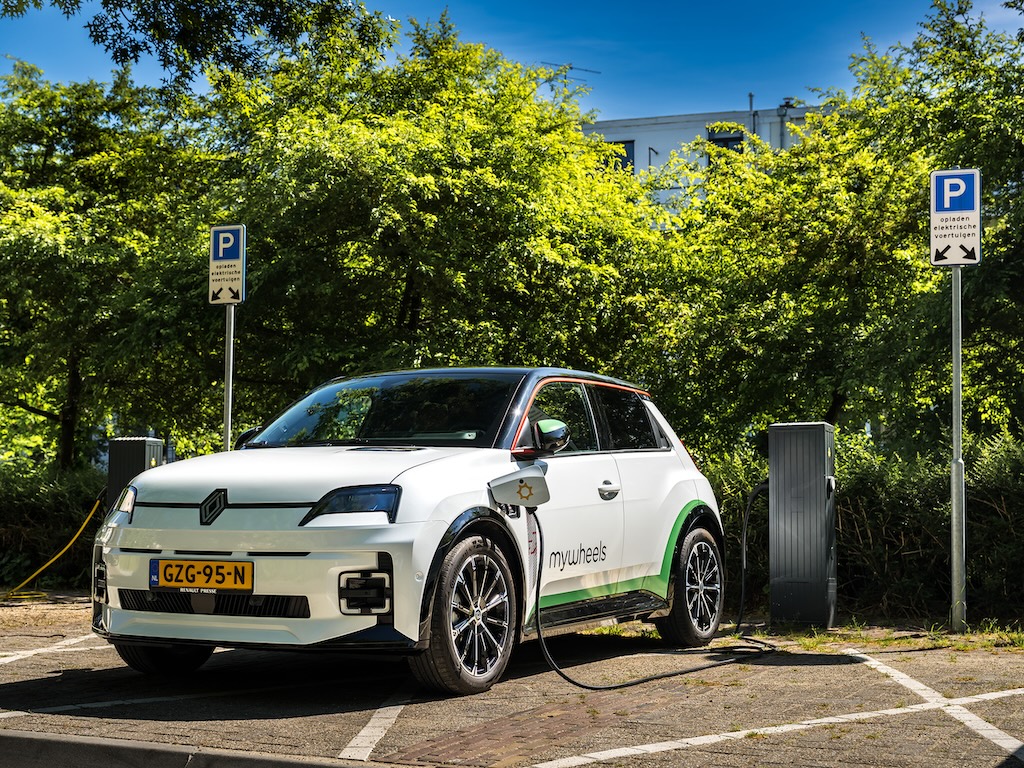
Already, 50 Renault 5 E‑Tech electric cars are available via a car‑sharing service managed by MyWheels
Developed under a collaboration between Renault Group, MyWheels and We Drive Solar, together with the Municipality of Utrecht, the service will offer 500 electric models married up to V2G bi-directional charging technology developed by Mobilize, Renault Group’s sustainable mobility arm.
Already, 50 Renault 5 E‑Tech electric cars are available via a car‑sharing service managed by MyWheels and the fleet will soon include the Renault 4 E‑Tech electric, Megane E‑Tech electric and Scenic E‑Tech electric.
The solution is designed to stabilise the grid while giving Utrecht residents an affordable, sustainable mobility solution.
The 500 bidirectional cars can deliver 10% of the flexibility required in the Utrecht region to balance solar‑ and wind‑generated electricity at peak times.
Thanks to the V2G technology, electric vehicles can store energy and feed it back to the local grid during peak periods, so renewable power remains available around the clock.
The Netherlands is a global leader in solar and wind-based energy deployment, and Utrecht ranks among Europe’s most progressive renewable‑energy cities, with 35% of roofs equipped with solar panels.
We Drive Solar, an international specialist in smart charging, provides advanced charging solutions, providing bidirectional public AC chargers and aggregation technology that support Mobilize’s V2G toolkit.
Renault Group has also called for action to help “unleash” V2G services via a supportive regulatory framework that addresses barriers such as unfavourable tax policies, grid fee structures and complex certification processes.
Jérôme Faton, Mobilize Energy director, said: “To unlock the full potential of V2G, we need to break down existing barriers – from adapting fiscal rules and grid fees to promoting interoperability and simplifying certification processes. With the right alignment, V2G can become a cornerstone of tomorrow’s grid.”
MobilizeMyWheelsRenault GroupUtrechtV2GWe Drive Solar
Natalie Middleton

Natalie has worked as a fleet journalist for nearly 20 years, previously as assistant editor on the former Company Car magazine before joining Fleet World in 2006. Prior to this, she worked on a range of B2B titles, including Insurance Age and Insurance Day. Natalie edits all the Fleet World websites and newsletters, and loves to hear about any latest industry news - or gossip.