
CityFreighter fundraises to scale up purpose-built modular EV platform for speciality fleets
Clean tech startup CityFreighter is continuing fundraising to scale up its plans for a purpose-built modular EV platform for speciality fleets.
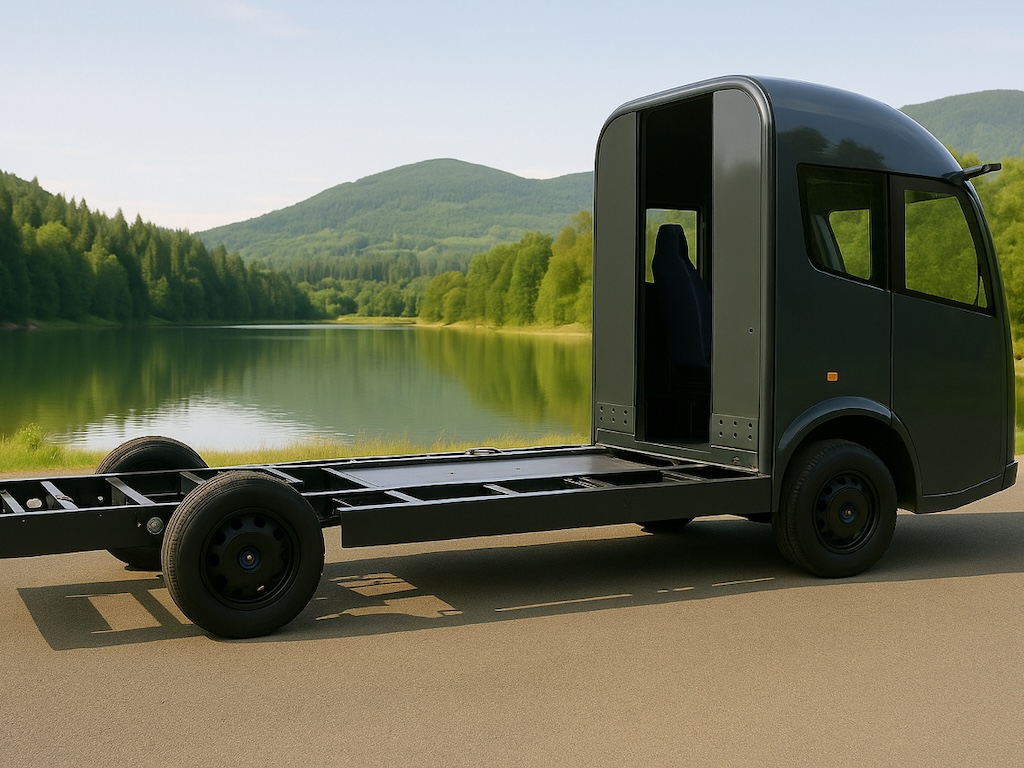
CityFreighter’s business model focuses on commercialising its 4.25t GVW EV chassis for specialised markets
The German- and US-based firm is seeking additional funding from international investors to move from R&D into commercialisation for its 4.25-tonne GVW electric vehicle chassis for specialised markets.
The investment will help establish engineering centres in the UK and the Middle East, most likely Saudi Arabia or the United Arab Emirates.
CityFreighter has previously secured £2.7m ($3.5m) and is now seeking an additional £3.8m ($5m) in this funding round.
The total amount needed to reach serial production is estimated at £30m ($40m), which will be raised through successive funding rounds to complete homologation and become fully production-ready by 2028. The current round is focused on pilot validation, following the construction of two prototypes to test its low-floor concept.
CityFreighter is led by founder and chief executive Michael Schoening, and supported by a team with experience at automotive companies such as Bosch, Daimler, Ford, Lightyear, Lotus and Morgan.
“Our growth strategy involves localising engineering in the UK and semi-knockdown assembly across Europe, the Middle East, the United States and Mexico, ensuring cost efficiency and quick expansion,” said Schoening. “CityFreighter addresses a notable gap in the commercial electric vehicle market, where traditional OEMs focus on high-volume production, leaving specialised fleets without options.”
CityFreighter’s business model focuses on commercialising its modular 4.25-tonne GVW electric vehicle chassis for specialised markets, targeting high-value potential in the global commercial vehicle industry. The company’s low-floor platform is suitable for various niche applications, from low-mileage last-mile delivery trucks to high-mileage recreational vehicles.
The company said the platform targets markets often overlooked by major OEMs, generating volume by supporting numerous duty cycles and offering customised options for different uses, such as emergency response vehicles.
The company’s business model is built on six different areas of scalable growth, including vehicle sales, platform licensing, fleet software, battery subscriptions, energy services and customisation.
Its modular, ultra-low-floor cab-chassis platform is specifically designed for bodybuilders and specialised OEMs, offering flexibility, scalability and readiness.
The platform includes an adaptable battery bay, open mechanical and digital interfaces, and future-ready technology such as an 800V system, over-the-air updates, bidirectional charging, and AI-driven fleet management.
Targeted markets include last-mile logistics, recreational vehicles, shuttle buses, food trucks, emergency units and service vehicles.
The flexible chassis cab is set up to enable different battery sizes, allowing the use of smaller batteries in urban areas where daily travel usually covers around 50km (31 miles). The vehicle’s range can, however, exceed 400km (c.250 miles) with a second battery installed.
“The global electric commercial vehicle market is expected to grow substantially, especially as specialised, modular platforms gain popularity for fleet customisation and can adapt to various customer needs,” said Schoening. “Light commercial electric vehicle sales increased by over 40% in 2024, surpassing 600,000 units worldwide. The 4.25-tonne GVW segment is projected to be the fastest-growing vehicle category, so we aim to secure a significant market share driven by increased recreational activities, as well as e-commerce and last-mile delivery needs.”
Natalie Middleton

Natalie has worked as a fleet journalist for nearly 20 years, previously as assistant editor on the former Company Car magazine before joining Fleet World in 2006. Prior to this, she worked on a range of B2B titles, including Insurance Age and Insurance Day. Natalie edits all the Fleet World websites and newsletters, and loves to hear about any latest industry news - or gossip.